REVIEW · BANFF
The Sights of Banff: a Smartphone Audio Walking Tour
Book on Viator →Operated by Tripvia Tours · Bookable on Viator
Banff has a story you can walk and hear. This smartphone audio walking tour lets you explore town landmarks at your own pace, with commentary that plays as you reach each stop using live GPS.
What I like most is the freedom: you can start anytime and stop or jump back in along the route whenever you want. The other big win is the app experience itself: offline audio plus a built-in trivia game keeps it from feeling like a lecture. The main drawback to plan for is that the interface and directions can be hit or miss, so you’ll want good phone battery and a backup plan for finding the exact spot.
In This Review
- Key highlights to watch for
- Why this Banff audio walk works better than most guided tours
- Getting started at 12 Banff Ave: the app, offline downloads, and GPS flow
- The Buffalo Nations Museum and Banff Administration Building: start with Banff’s timeline
- Cascades of Time Gardens and the Banff Pedestrian Bridge: parks, pavilions, and Mr. Banff
- Buffalo Street and Ken Madsen Path: elevation clues, early buildings, and climate context
- Luxton Home Museum and Caribou Corner: pioneer homes you can actually see
- Cave and Basin mural, Central Park rocks, and visitor help on site
- Museums and monuments: Whyte Museum, Banff Park Museum, and the park’s teaching moments
- Historic blocks along Banff Ave: Dave Whyte, Harmony Lane, and the rustic park style
- Rundle United, the Superintendent’s Residence, and the Banff Legion cenotaph
- Walking the rest of Banff: the spots you’ll pass and why it still feels worthwhile
- Price and value: $8.22 for a DIY guided-style experience
- When this tour is the best fit for you
- Should you book this Banff smartphone audio walking tour?
- FAQ
- How long is the Banff smartphone audio walking tour?
- Where does the tour start and end?
- Do I need mobile data during the tour?
- Do I need headphones?
- Can I start at any time and stop during the route?
- Is this tour private?
- Are museum and attraction tickets included?
- How does the audio know when to play at each stop?
- Is the tour offered in English?
- Is there free cancellation?
Key highlights to watch for

- Offline-ready audio: Download on Wi‑Fi before you go so the walk doesn’t depend on signal.
- GPS-triggered narration: Commentary starts automatically as you get close to each point.
- Self-paced route: No strict timing, with the ability to stop and restart along the way.
- Banff Avenue focus: A practical loop that centers on the town’s historic core and key viewpoints.
- Trivia game included: Short, fun location-based questions to keep you alert while you walk.
- A deal for the length: About 1 to 1.5 hours covering roughly 5 km, for a low per-person price.
Why this Banff audio walk works better than most guided tours
Banff’s pretty, but it’s the town details that make it memorable: old buildings, bridge stories, street markings, and the way the early park era shaped modern Banff. This tour is designed for that kind of attention, not for rushing from one photo spot to the next.
You get a professional “guide voice” through your phone, but without the pressure of a group. That matters in Banff, where busy sidewalks and limited time can turn even a good tour into a hurry-up exercise.
Other Banff townsite walking tours we've reviewed in Banff


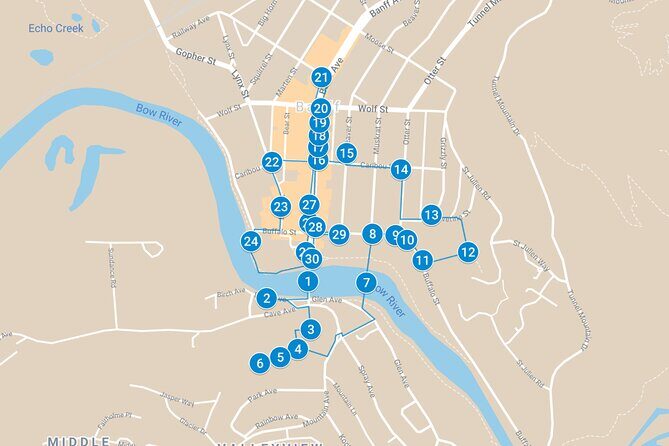
Getting started at 12 Banff Ave: the app, offline downloads, and GPS flow

The tour begins at 12 Banff Ave, and you end right back where you started. You’ll be walking around town with frequent stops, many clustered along Banff Avenue and the nearby streets off it.
Before you leave, do the easy step that makes the whole thing work: download the tour on Wi‑Fi. The walk is built so you don’t need mobile data or a signal during the experience, which is a lifesaver in town’s sometimes-stressful phone coverage.
Then it’s basically: follow the live GPS map, walk to the next highlighted location, and listen. As you get close, the audio commentary plays automatically. If you’re the kind of person who likes to read street signs and look up at architecture, this format fits you well.
One practical note: the app audio can play from your phone speaker if you don’t have headphones. If you do have headphones, they’re a good idea for clarity and to block street noise—Banff Ave can get busy.
The Buffalo Nations Museum and Banff Administration Building: start with Banff’s timeline
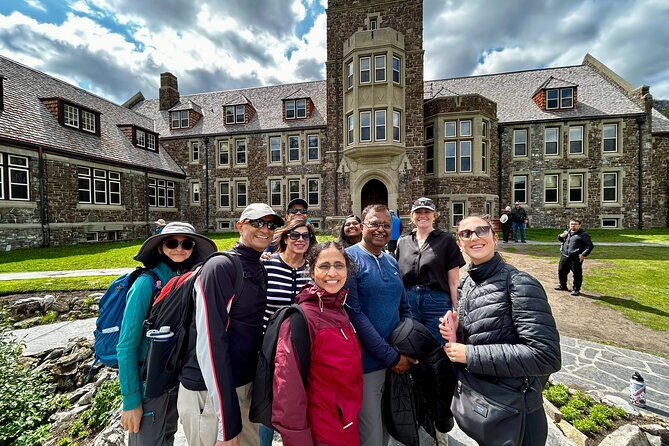
You kick off with the Buffalo Nations Museum, an opening stop that sets a strong sense of place. Expect a mix of Banff past and present as you move through the area, plus a walkthrough that points out specific landmarks like the Banff Administration Building area, Luxton Home Museum, Central Park, and the Cascades of Time Gardens.
This first stop is also where the tour’s “hear it, then look” style shows up. You’re not just listening while walking—you’re learning what to notice when you see it.
After that, you’ll hit the Banff National Park Administration Building. The narration focuses on what you’re seeing while you’re staring at it (yes, that’s the whole point). This is a quick stop on the audio track, but it’s one of the key heritage anchors for understanding how Banff developed under the national park system.
Potential drawback to keep in mind: a few app experiences can feel like you need to get the rhythm of the interface first. Once it clicks—GPS location, audio triggers, and what “next” means—the tour gets much easier to follow.
Cascades of Time Gardens and the Banff Pedestrian Bridge: parks, pavilions, and Mr. Banff
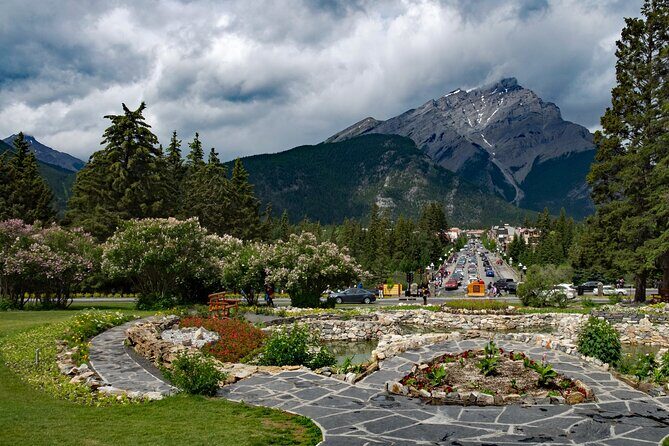
Next comes the Cascade Gardens, a real change of pace. You’ll be in a 4‑acre park built in the 1930s, terraced into a hillside. The audio points out two specific areas: the Cambrian and Devonian pavilions.
Even if you don’t usually “garden tour” on vacation, this stop gives you something useful: a sense of how Banff packaged nature and design for visitors long before social media made every walkway a destination.
Then you’ll cross over toward the Banff Pedestrian Bridge, where the audio pivots to character. The narration explains the story behind the man known as Mr. Banff while you get a wide look over the Bow River. This is one of those spots where audio adds context to the view, instead of repeating what you already see.
A tip for this section: slow your pace on the bridge and let the audio finish, even if you feel tempted to keep moving. The viewpoint is the main event.
Buffalo Street and Ken Madsen Path: elevation clues, early buildings, and climate context
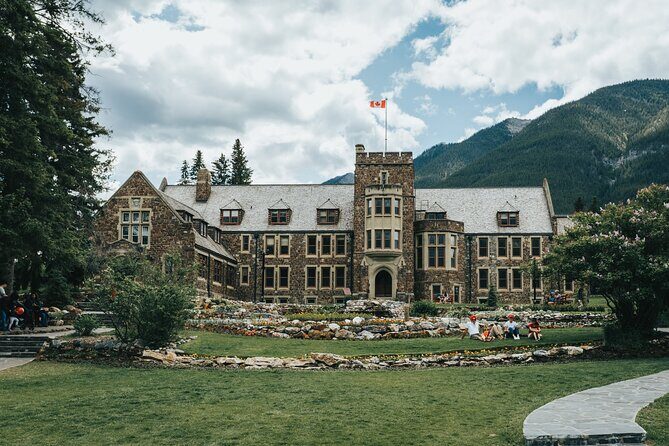
From the bridge, the tour starts getting fun and specific on the details. You’ll stop at Buffalo Street & Muskrat Street to hunt for the elevation marker. The audio tells you what it means, and it’s the kind of sidewalk clue that’s easy to miss on your own.
Right after, you’ll pass 514 Buffalo St and learn about the Crandell Peck Cabin, built in 1907 by Edward Henry Crandell, using almost entirely locally sourced materials. This is a short stop, but it’s exactly the kind of heritage pocket Banff has all over the place.
Then comes a small visual lesson at Buffalo Street & Otter Street with an inukshuk—the narration explains what it is and why it matters. Inukshuks are common, but context makes them more meaningful.
At 525 Buffalo St #521, the tour shifts into infrastructure with the Banff Powerstation. You’ll learn how it powered the town’s streetlights and homes in 1905. This is great if you like the “how did this place function” side of travel, not just the scenic side.
From there, you’ll walk the Ken Madsen Path, where the narration provides more general history as you move along. It’s a short audio segment, but it helps connect the street-level sights to the bigger story.
Next is 117 Grizzly St, the Tarry-a-while residence, tied to Mary Schaffer Warren. The audio spotlights her early explorations and her work as a writer and painter connected to the Canadian Rockies. Even on a tight timeline, this kind of human story makes the whole walk feel less like memorizing facts.
At Otter Street & Caribou Street, you’ll get a climate-focused stop. The narration keeps it short, but it’s useful background for what you’ll experience as seasons change in Banff.
Other walking tours we've reviewed in Banff


Luxton Home Museum and Caribou Corner: pioneer homes you can actually see

Two stops here are about how people lived, not just what buildings look like.
At Luxton Home Museum, the audio guides you through the historic home and the pioneer family story over nine decades. Admission is not included, so treat it like an optional upgrade if it’s open when you’re there. Either way, the exterior and surrounding context still help the narration make sense.
Then you’ll head to Caribou Street & Banff Avenue at Caribou Corner, learning about the Brewster family, who arrived in 1886 and set up shop. This is one of those “town origin” stories that makes today’s storefronts feel like they didn’t appear out of nowhere.
A great detail next is at 204 Banff Ave, where you’ll notice the four sentries sculpture. The audio gives you the meaning so you’re not just taking a picture and moving on.
Cave and Basin mural, Central Park rocks, and visitor help on site

One of the more memorable quick stops is Box 3100, where a mural depicts the Cave & Basin site. The audio explains it so you understand why that location mattered to Banff’s early story. If you’re planning any other sights later, this mural can be a useful trigger to check Cave & Basin timing.
Then you’ll reach the Banff Visitor Information Centre. It’s not just a “walk by” stop; it’s your practical chance to get current ideas—hours, current conditions, and what’s worth prioritizing beyond this walk.
After that, you’ll pass through Central Park, where the audio focuses on a big pile of rocks in the middle. It sounds silly, but that’s the point: the tour teaches you what to look for instead of letting you wander without a checklist.
Museums and monuments: Whyte Museum, Banff Park Museum, and the park’s teaching moments

The next part takes you through areas tied to Rocky Mountain culture and the park’s early documentation.
At the Whyte Museum of the Canadian Rockies, the tour points out what the museum is and what it tries to preserve and make accessible. Admission is not included, so you’ll want to check whether it fits your budget and time.
Then comes the Banff Park Museum, also ticketed. The audio explains that it’s a National Historic Site of Canada established in 1895, originally intended to house taxidermy specimens of animals, plants, and minerals associated with the park. If you like museum stops, this is one of the most specific and “you’re learning while you’re standing there” segments on the route.
The payoff is that the museum focus doesn’t stay locked indoors. You keep seeing how Banff chose to interpret the park’s natural world for visitors, then you can compare that with what you see outside.
Historic blocks along Banff Ave: Dave Whyte, Harmony Lane, and the rustic park style
You’ll pass Banff Avenue & Buffalo Street to learn about the Dave Whyte block, described as one of the oldest remaining, largely intact commercial buildings in Banff. This is the kind of short, useful stop that helps you read Banff as an old town, not just a resort town.
Next is 107 Banff Ave and Harmony Lane, a commercial building in a rustic National Park style with river stone pillars. The audio keeps it brief, but it gives you the vocabulary to notice craftsmanship instead of glossing over it.
These are quick stops, but they add up. By the time you’re halfway through the route, the buildings start to feel like evidence, not decoration.
Rundle United, the Superintendent’s Residence, and the Banff Legion cenotaph
At Rundle United (Ralph Connor Memorial United Church), you’ll hear about the man behind the church’s name. The audio moment mentions the guide character Don doing a Mr. Rundle impersonation, which gives the stop a bit of playful personality without turning it into a skit.
Then at Beaver Street & Buffalo Street, the tour points out the Superintendent’s Residence. You’ll learn what the park superintendent’s job responsibilities were, and that the superintendent lived in this residence. This helps connect the historic administration role to the physical town footprint.
Finally, you’ll end with Royal Canadian Legion Col. Moore Branch 26, seeing the Banff Legion and the cenotaph in front, built in 1920. It’s a fitting close: the tour started with place and park foundations, then it lands on memory and community.
Walking the rest of Banff: the spots you’ll pass and why it still feels worthwhile
Along the way, you’ll also be walking up and down Banff Avenue and passing nearby points where you can linger. Even when a stop isn’t the big audio moment, having narration that guides your attention makes a casual stroll feel directed.
This tour’s structure also helps if you’re mixing sightseeing with errands. The audio lets you build a loop that’s flexible enough to work around meals and shopping while still covering heritage highlights.
Price and value: $8.22 for a DIY guided-style experience
At $8.22 per person for about 1 to 1.5 hours, this is one of the best ways to get a guided-style introduction to Banff without paying guided-tour premiums. What you’re really buying is time-saving context: you get explanations timed to your walking position, so you’re not doing your own research between stops.
You also avoid the usual tradeoff of group tours. There’s no need to “keep up,” and you can pause when your feet need it. In Banff, that flexibility is often worth more than paying extra for a live guide.
The one cost consideration: some stops are admission ticket not included, including the Buffalo Nations Museum, Luxton Home Museum, Whyte Museum, and Banff Park Museum. If those are must-dos for you, budget for tickets separately. If you’re mainly after the guided walking context, you can keep it low-cost by treating those as optional.
When this tour is the best fit for you
This is a strong match if you want:
- a self-paced walk through Banff’s core (especially along Banff Avenue),
- a heritage-first way to see town without joining a crowd,
- an audio experience that works offline once downloaded,
- and a route format that doesn’t lock you into a strict schedule.
It’s also a good option for a first day in town. You get the feel of Banff’s old buildings, park-era systems, and the key landmarks that will make your later sightseeing more meaningful.
Should you book this Banff smartphone audio walking tour?
I’d book it if you like independent travel and you’re happy to let your phone act as the guide. The offline download, GPS-triggered narration, and the “stop anywhere” style make it a practical way to cover a lot of Banff in a short time.
Skip or rethink it if you expect perfect app guidance every step of the way. A couple of risks are worth knowing: the directions can be harder to follow than you’d hope, and some stop content may feel less helpful if the area changes or access is different. Also, it’s a lot of walking, so a cold day can turn “short stops” into a slog.
If you’re the kind of person who likes to look closely and learn while you walk, this is a solid value play for Banff. Download ahead, charge your device, and use the live map as your main guide—and you’ll have a much smoother time enjoying what Banff has to say.
FAQ
How long is the Banff smartphone audio walking tour?
The tour runs about 1 hour to 1 hour 30 minutes.
Where does the tour start and end?
It starts at 12 Banff Ave, Banff, AB T1L 1A1, Canada and ends back at the same meeting point.
Do I need mobile data during the tour?
No. You download the tour on Wi‑Fi before you start, and the tour is designed to work without a signal or data during the walk.
Do I need headphones?
Headphones are not included, and audio can play from your device speaker too. Using headphones is optional.
Can I start at any time and stop during the route?
Yes. You can start flexibly and you can stop and start anywhere along the route, with no time constraints.
Is this tour private?
Yes. It’s a private activity, so only your group participates.
Are museum and attraction tickets included?
No. Several stops list admission ticket not included, including the Buffalo Nations Museum, Luxton Home Museum, Whyte Museum of the Canadian Rockies, and Banff Park Museum.
How does the audio know when to play at each stop?
The tour uses a live GPS map. When you get close to a point of interest, the commentary automatically plays.
Is the tour offered in English?
Yes, it’s offered in English.
Is there free cancellation?
Yes. You can cancel up to 24 hours in advance for a full refund.